Written by
Dr. Ida Baizura Bahar
Senior Lecturer, Department of English
Faculty of Modern Languages and Communication, Universiti Putra Malaysia
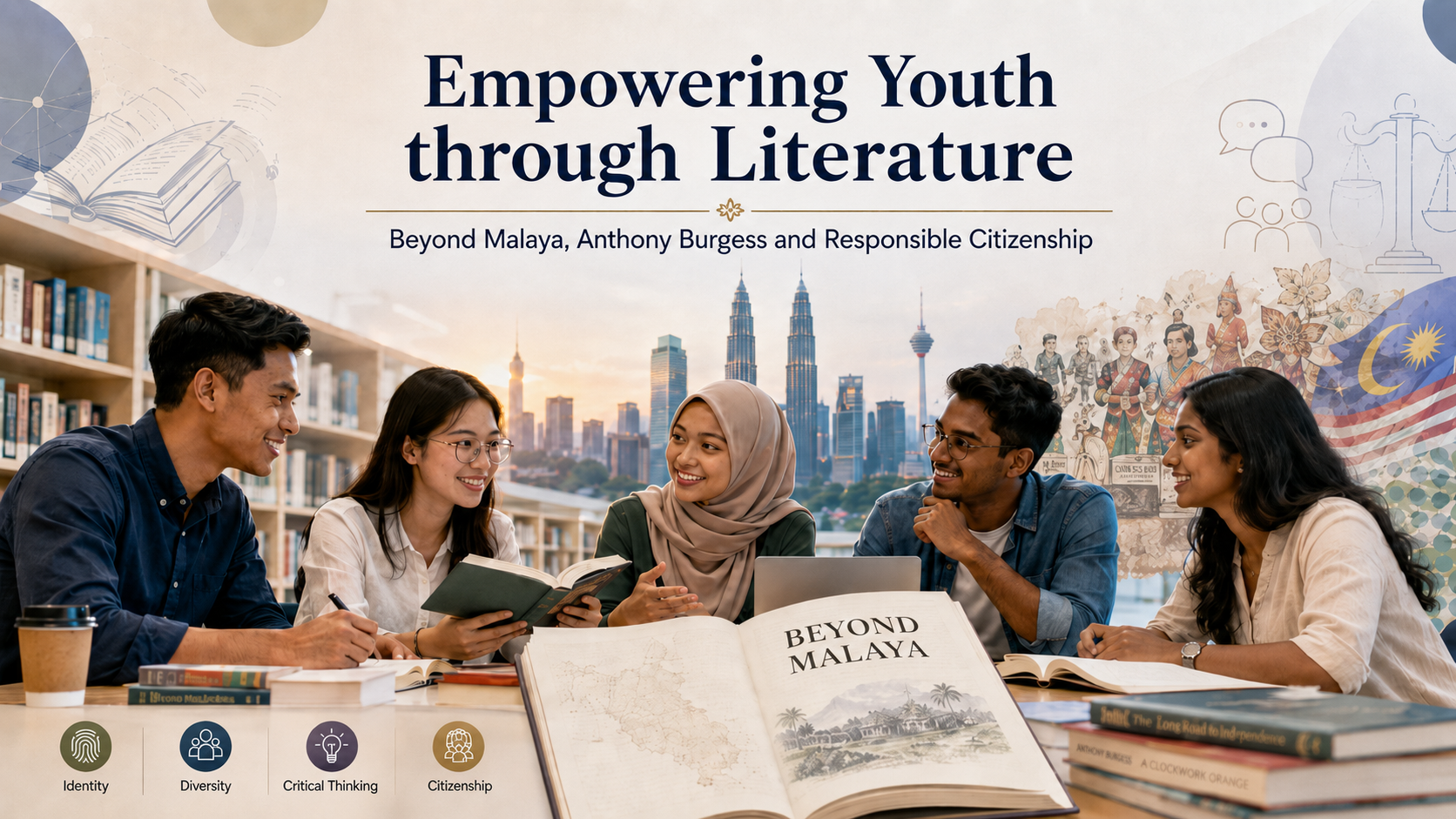
Young people are not merely future citizens; they are active participants in shaping society today. Developing young people who can think critically, understand cultural differences, and engage responsibly with their communities is essential to building an inclusive and resilient nation. Literature can contribute to this process by exposing young readers to different histories, perspectives, identities, and social experiences. In this context, Beyond Malaya: Visions of Bangsa Malaysia in The Malayan Trilogy by Anthony Burgess (2026) provides a valuable platform for connecting literary engagement with youth leadership and citizenship.
Beyond Malaya examines Burgess’ The Malayan Trilogy, comprising Time for a Tiger (1956), The Enemy in the Blanket (1958), and Beds in the East (1959), and explores representations of Malaya, cultural encounters, identity, and shared belonging. Its engagement with the concept of Bangsa Malaysia provides a foundation for encouraging young people to reflect on what it means to belong to a diverse society.
For young people, questions of identity and belonging are closely connected to citizenship. Growing up in a multicultural society requires an understanding that identities can be complex and shaped by historical and social experiences. Beyond Malaya creates opportunities for young readers to examine how different communities interact, negotiate differences, and respond to social change. Through Burgess’ representation of Malaya, young people can be encouraged to question fixed assumptions about culture, identity, and community.
This process of questioning is fundamental to youth leadership. Leadership requires the ability to listen, understand different perspectives, evaluate information, and respond thoughtfully to complex situations. Engagement with literary narratives can cultivate these capacities by requiring young readers to consider characters and societies from multiple perspectives. Rather than providing simple answers, literature creates spaces for interpretation, discussion, reflection, and informed judgement. These experiences can help young people develop the confidence required to make responsible decisions and engage constructively with others.
The concept of Bangsa Malaysia further strengthens the connection between literature and youth citizenship. Shared national identity does not require the elimination of cultural differences. Instead, young people can learn to understand diversity as an important component of collective identity. Beyond Malaya encourages reflection on how belonging can be constructed across cultural and social differences, providing a basis for discussing inclusion, mutual respect, dialogue, and social responsibility.
Burgess’ representation of colonial Malaya encourages readers to question how history is represented and whose perspectives are prioritised. Young readers can examine how cultural and political circumstances influence individual experiences and how narratives shape perceptions of communities. Such critical engagement is particularly important in an environment where young people encounter information from multiple sources and must evaluate competing perspectives.
Beyond Malaya also connects scholarly research with educational practice. The book integrates archival findings, critical commentary, and contextual materials and has been incorporated into literature and research-based courses. This approach provides young learners with opportunities to move beyond passive consumption of information towards investigation, interpretation, and discussion. Students can, therefore, see themselves not simply as recipients of knowledge but as active participants in producing meaning.
Youth leadership also requires empathy and intercultural understanding. Young leaders increasingly operate in culturally diverse environments characterised by different perspectives and experiences. Exposure to literary representations of different communities can encourage readers to consider experiences beyond their own. Through discussion and critical interpretation, literature can help young people recognise difference without treating it as division.
The questions emerging from Beyond Malaya remain relevant to young people today: What does it mean to belong? How can different cultural identities coexist? What responsibilities accompany citizenship? How should young people respond to historical inequalities? How can diversity become a source of strength rather than division? These questions encourage young readers to connect historical knowledge with contemporary social realities.
Ultimately, Beyond Malaya demonstrates how literary engagement can contribute to youth development, leadership, and responsible citizenship. Its exploration of Burgess’ representation of Malaya and the concept of Bangsa Malaysia provides a platform for young people to examine identity, history, diversity, and belonging critically. It also encourages qualities essential to effective citizenship: curiosity, critical thinking, empathy, dialogue, responsibility, and respect for different perspectives.
Date of Input: 14/08/2026 | Updated: 14/08/2026 | alyarahim
MEDIA SHARING