Written by
Assoc. Prof. Dr. Haliza Abdul Rahman
Head, Laboratory of Youth in Leadership, Politics and Citizenship (IPSAS)
Department of Environmental and Occupational Health, Faculty of Medicine and Health Sciences, UPM
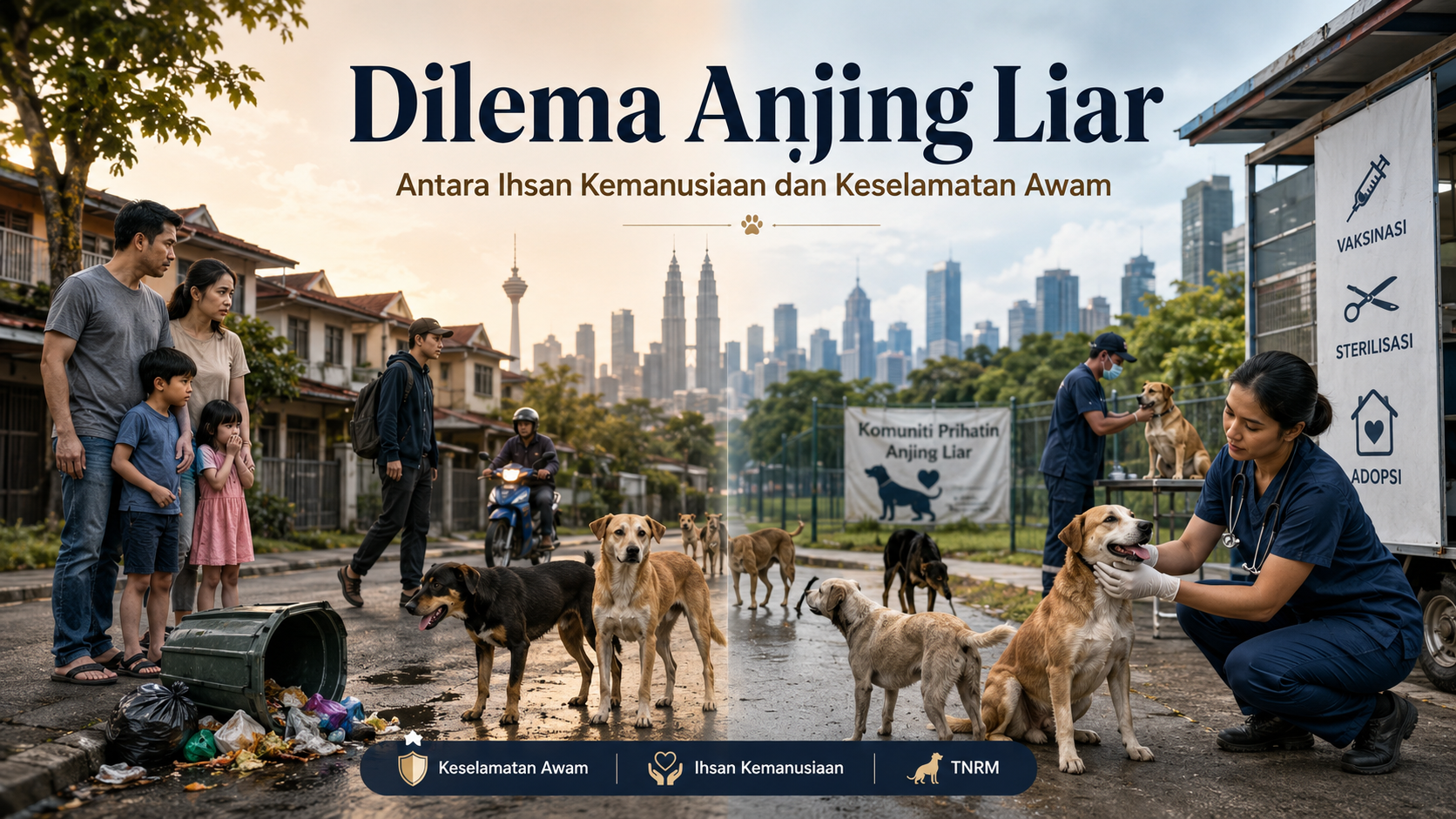
The growing population of stray dogs in residential areas and public premises is no longer merely an issue of environmental cleanliness; it has evolved into a social, public health and ethical dilemma that poses a significant challenge to local authorities and the wider community. In some urban and suburban areas, the estimated presence of more than 200,000 to 300,000 stray dogs, based on estimates by various animal welfare non-governmental organisations (NGOs) across Malaysia, has created genuine concern among residents due to the risk of physical attacks and the spread of zoonotic diseases. At the same time, animal protection organisations advocate for the ethical protection of these animals and their right to be free from cruelty. The conflict between the priority of human safety and the humane treatment of animals requires a sustainable, data-driven analysis so that any solution reached is not only effective in terms of control, but also ethically sound.
From a public health and safety perspective, the uncontrolled presence of stray dogs in large numbers poses a tangible risk to community well-being. The most critical threat is the spread of rabies, a fatal viral infection with a potential mortality rate of 99% once clinical symptoms appear. According to data from the World Health Organization (WHO), rabies causes approximately 59,000 human deaths worldwide each year, with 95% of cases occurring in Asia and Africa as a result of dog bites. In Malaysia, Sarawak declared a rabies outbreak in July 2017, which continued through 2024, during which the Sarawak State Health Department recorded more than 70 cases of rabies encephalitis in humans, with a mortality rate exceeding 90%. High-profile cases, such as the death of a six-year-old boy in Sibu in 2020 following a stray dog bite to the leg, highlight the vulnerability of the public safety control system.
In addition to the risk of infection, attacks by dogs moving in groups, or exhibiting a “pack mentality”, can also cause trauma and serious accidents. For example, in December 2023, a 76-year-old woman in Kota Kinabalu, Sabah, sustained severe injuries to her head and body after being attacked by a group of stray dogs while walking in her residential area. Incidents involving motorcyclists who are injured in road accidents while attempting to avoid or escape from stray dogs at night have also been increasingly reported in states such as Perak, Kedah and Selangor. There are also concerns relating to cleanliness and public order, as dogs rummaging through rubbish bins can scatter solid waste, create unpleasant odours and attract other disease-carrying animals such as rats. Continuous barking at night can further disrupt residents’ sleep quality.
Conversely, from the perspective of activists and NGOs such as the Society for the Prevention of Cruelty to Animals (SPCA) and the PAWS Animal Welfare Society (PAWS), stray dogs are not the primary cause of the problem but are instead victims of human failure. Animals’ right to live free from pain, suffering and killing should be respected in accordance with the Five Freedoms of Animal Welfare. A key cause of the growing stray dog population is irresponsible pet ownership, particularly when owners refuse to neuter their animals and subsequently abandon unwanted puppies in markets, industrial areas or by the roadside. According to international statistics, a pair of unneutered dogs and their offspring can produce up to 67,000 dogs within six years through exponential breeding. Population-clearing measures based on mass euthanasia, including large-scale killing, shooting or cruel capture using metal hooks, often face strong public opposition because they are regarded as inhumane and have been shown to be ineffective as a long-term solution due to the Vacuum Effect. In the context of stray animal population management, this ecological phenomenon indicates that when an area is cleared through killing, the vacant space and available food resources are quickly occupied by new stray dog populations from neighbouring areas.
To achieve a balance between safeguarding public safety and maintaining humane treatment of animals, a holistic approach grounded in data and international best practices should be implemented on a continuous basis. The Trap-Neuter-Release-Manage (TNRM) method, as recommended by the WHO and the World Organisation for Animal Health (WOAH), is presented as a sustainable strategy in which dogs are captured, neutered, vaccinated against rabies and marked before being released in a controlled manner. George Town, Penang, provides an example in Malaysia, where collaboration between the Penang Island City Council (MBPP) and the NGO International Aid for Animals Foundation (IAPWA) through a TNRM programme since 2017 has neutered and vaccinated thousands of stray dogs, helping to stabilise the population without relying solely on culling. These technical measures should be complemented by strict legal enforcement by local authorities and the Department of Veterinary Services (DVS), including mandatory dog licensing and microchipping. Owners found to have abandoned animals should be subject to action under the Animal Welfare Act 2015 (Act 772), which provides for fines ranging from RM20,000 to RM100,000 or imprisonment for up to three years.
Another approach involves establishing ethical-standard animal sanctuaries through strategic collaboration among state governments, local authorities and NGOs to provide temporary shelters that meet animal welfare standards, while also promoting adoption campaigns such as “Adopt, Don’t Buy” among the public. Finally, education and public awareness campaigns on responsible pet ownership, together with safety guidance on how to respond when encountering stray dogs, should be introduced from the school level onwards.
The issue of stray dog threats should not place animal rights and human well-being at opposing extremes. Community well-being cannot be built on cruelty towards other living beings, while animal rights should not come at the expense of human safety and public health. Through firm enforcement of the law, science-based population control programmes and responsible community attitudes, a safe and harmonious environment for all can be created.
Date of Input: 13/08/2026 | Updated: 13/08/2026 | alyarahim
MEDIA SHARING